


 United States
 Best Seller
 Label Printers
 All PDAs
 All Tablets
 All Thermal Labels
 Printer Accessories
When your business handles cash daily, accuracy and efficiency are essential. Whether you manage a retail store, restaurant, bank, vending route, or any cash-based operation, choosing the right money counting machine can save hours of manual labor, reduce errors, and improve cash management.
The two most popular types of money counting machines on the market are bill counters and mixed denomination counters. While they may seem similar at first glance, their functionality and impact on your cash-handling workflow are quite different.
Let's break down how these machines work, their key differences, and how to decide which one is the best fit for your business.
Why Use a Money Counting Machine?
Counting cash manually is time-consuming, error-prone, and tedious, especially when dealing with large amounts or mixed denominations. A money counting machine, whether a basic bill counter or an advanced mixed denomination counter, can transform this process into a quick, seamless task.
One of the biggest advantages of these machines is speed. Manual counting isn't only slow, but also increases the likelihood of mistakes. In contrast, many money counters can process between 800 to 1,500+ bills per minute.
Compared to manual counting, which can take several minutes for large batches, a money counting machine completes the task in seconds. This speed is especially valuable during end-of-day cash reconciliation, bank deposits, or cash-heavy business days. On top of that, advanced models with counterfeit detection provide an extra layer of security, helping you avoid the costly mistakes of accepting fake or damaged bills.
For small businesses, these benefits translate into saved labor costs, fewer counting errors, faster closing times, and more reliable accounting. This makes a strong case for investing in a quality mixed denomination counter, which offers more advanced features compared to basic bill counters.
What Are Bill Counters and Mixed Denomination Counters?
Standard Bill Counter
A bill counter is designed to count a stack of bills quickly, but with one limitation: the bills must all be of the same denomination. For example, if you load a stack of $20 bills, the machine will count how many bills are in the stack but won't calculate the total dollar value.
Some advanced models may include a "value count" or "mixed value" mode, but for the most part, standard bill counters are focused on counting the number of notes rather than their monetary value.
How it works:
- Place a stack of the same-denomination bills into the hopper.
- Sensors detect and count each bill as it passes through.
- The machine provides a total count of the bills (e.g., 100 bills).
Mixed Denomination Counter
A mixed denomination counter, also known as a "currency discriminator", is a more advanced type of bill counter. It can handle a stack of bills with various denominations (e.g., $1s, $5s, $10s, $20s, $50s, $100s mixed together) and, in a single pass:
- Recognize the denomination of each bill using optical sensors/image recognition.
- Count the total number of bills.
- Calculate the total monetary value of the stack.
- Optionally sort bills by denomination, face, or orientation.
- Detect counterfeit or damaged bills (depending on the model).
In short, mixed denomination counters are value-based machines, while standard bill counters are count-based.
How Do Money Counting Machines Work?
At their core, both types of machines operate similarly: you place a stack of bills into the hopper; rollers feed individual notes through the machine; sensors detect and process each bill.
The difference lies in the sensors and processing capabilities:
- Standard Bill Counters: Sensors simply count the number of bills.
- Mixed Denomination Counters: Advanced sensors (such as optical image sensors or dual contact image sensors) read the denomination of each bill, detect counterfeit features (UV, IR, magnetic ink, thickness), and calculate the total value.
With mixed denomination counters, there's no need to manually sort bills before counting, just load the stack and let the machine do the work.
Standard Bill Counter vs. Mixed Denomination Counter
Standard Bill Counter
Pros:
✔ More affordable.
✔ Fast for same-denomination stacks.
✔ Simpler design, easier to maintain/calibrate.
Cons:
▶ Requires manual sorting by denomination before counting.
▶ Does not automatically calculate total dollar value (unless value-counting feature included).
▶ Not ideal for mixed stacks.
▶ Not likely to have advanced counterfeit detection (on cheaper models), increasing risk of fake bills.
Mixed Denomination Counter
Pros:
✔ Can handle mixed stacks.
✔ Automatically computes total value and denomination breakdown.
✔ Many models include counterfeit detection (UV, IR, magnetic, thickness, image-analysis).
✔ Faster and more efficient cash handling.
Cons:
▶ Higher cost.
▶ More complex and may require occasional maintenance, calibration, and cleaning of sensors.
▶ For very basic cash-handling needs (e.g., always same denomination, low volume), mixed-denomination features may be overkill.
When Should a Business Use Each Type?
When a Standard Bill Counter Makes Sense
- Your business primarily handles large amounts of cash in the same denomination (e.g., $20 bills for bank deposits).
- You don’t process mixed-bill batches frequently.
- You're on a tight budget and need an entry-level machine for basic counting tasks.
When to Choose a Mixed Denomination Counter
- Your business receives mixed bills from customers (e.g., retail stores, restaurants, or businesses consolidating multiple cash registers).
- You want to save time by skipping manual sorting.
- Accuracy and security are a priority as these machines handle denomination and counterfeit detection, and total value calculation automatically.
- You operate in a high-volume cash environment (e.g., retail chains, banks, or cash-heavy small businesses).
- You want better cash-flow tracking and reporting (some models even record serial numbers or print detailed reports).

Best Money Counter for Small Businesses
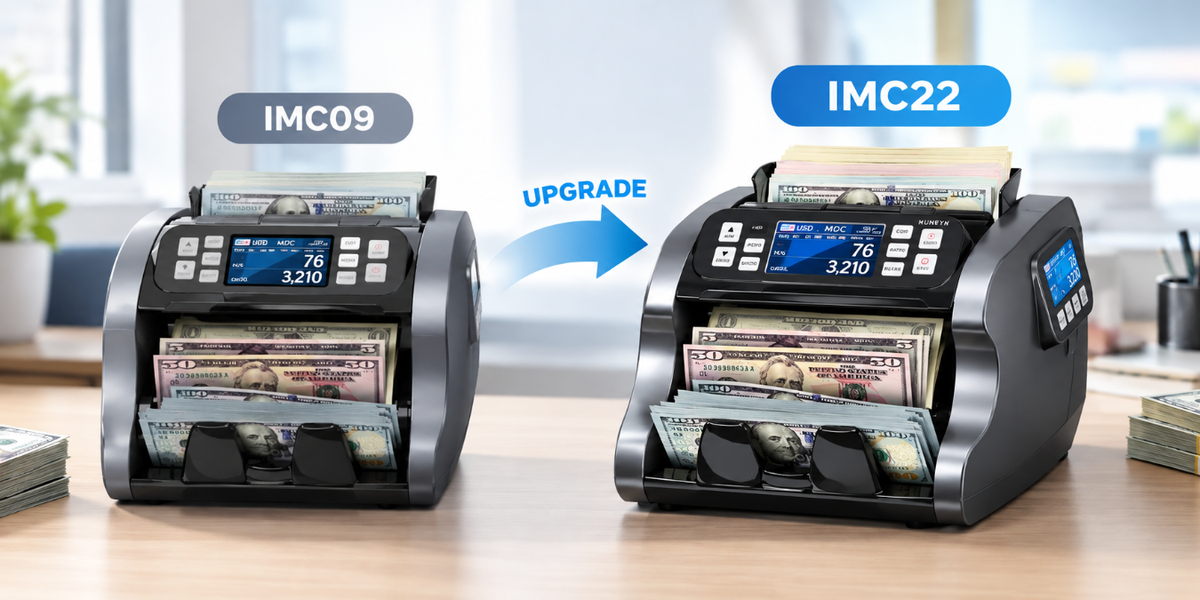
If you're a small business owner managing cash daily, investing in the right money counting machine can deliver big returns in time savings and accuracy. Among the many options available, MUNBYN money counters stand out as a reliable choice.
Why MUNBYN is a Smart Investment

- Mixed-Denomination Counting: Automatically detects and calculates the total value of mixed stacks, no manual sorting is required.
- Multi-Currency Support: Ideal for businesses that handle multiple currencies (USD, EUR, CAD, MXN, etc.).
- Advanced Security Features: Includes counterfeit detection methods like UV, IR, magnetic ink, and thickness detection. Some models even offer serial number recognition.
- Time Savings: Streamlines cash counting and reconciliation, especially for high-volume or mixed-cash environments.
- Scalability: MUNBYN offers models for businesses of all sizes, from compact counters to heavy-duty machines with reporting capabilities.
Investing in MUNBYN for Long-Term Efficiency
For most small businesses, a reliable money counter isn’t just a convenience. It’s a tool that saves time, reduces errors, and enhances security. MUNBYN strikes a perfect balance between affordability, advanced features, and performance.
By choosing a MUNBYN mixed-denomination counter, you can:
- Save hours of manual counting and sorting.
- Reduce human error and cash discrepancies.
- Protect your business from counterfeit risks.
- Scale your cash-handling process as your business grows.
Conclusion
While standard bill counters are great for simple cash workflows, mixed denomination counters offer unmatched convenience, speed, accuracy, and security for businesses handling varied denominations or high cash volumes.
By eliminating manual sorting, automatically calculating total values, and detecting counterfeit bills, mixed denomination counters streamline cash management and reduce errors.
If you're ready to upgrade your cash-handling process, investing in a quality MUNBYN mixed denomination money counting machine is a smart, long-term decision for your business. Use code “MYSEO” for an extra 8% off MUNBYN products. Discount may vary or expire at any time.

Share:
Thermal, Inkjet or Laser Printing: Pros & Cons for Your Business
How to Make Stickers with a Thermal Printer: A Complete Guide