


 United States
 Best Seller
 Label Printers
 All PDAs
 All Tablets
 All Thermal Labels
 Printer Accessories
If you've ever shopped for a bill counter, you've probably run into a wall of acronyms — UV, MG, IR, CIS, MT — with little explanation of what they actually do. For a retail manager, bank teller, or casino cage supervisor, that's a problem. You're not buying a gadget for fun; you're buying protection against a very real cost. Counterfeit bills don't get refunded. Once one slips into your drawer, that loss comes straight out of your bottom line.
This guide breaks down what each detection method actually checks, why no single one is enough on its own, and how to match the right combination to your business.
Why one detection method is never enough
Older counterfeit pens and basic UV-only scanners catch the obvious fakes — the kind printed on plain copy paper. But counterfeiters have gotten more sophisticated, and so-called "superdollars" and high-quality fakes can pass a single test while failing another. That's why modern bill counters layer multiple technologies together. Each one checks a different physical property of a genuine note, and a bill has to pass all of them to be accepted.
Here's what each one actually does — and the order they typically run in inside a bank-grade counter:

Figure 1. A bill must clear every detection layer — UV, MG, IR, and CIS — to be accepted. A single failed check is enough to flag and reject it.
UV (ultraviolet) detection
Genuine currency is printed with special inks and security threads that fluoresce under ultraviolet light in specific colors and positions — the US $20 bill glows green, for example. A UV sensor shines ultraviolet light on the note and checks whether the fluorescent pattern matches what's expected. This catches bills printed with regular ink, which won't react the same way or won't react at all.
UV is a strong first filter, but it's not foolproof. Some counterfeiters have learned to add fluorescent compounds to fake paper, which is exactly why UV is paired with other checks rather than used alone.
MG (magnetic) detection
Real banknotes contain tiny amounts of magnetic ink in specific areas of the design — often in the numerals or certain printed elements. An MG sensor reads the magnetic signature as the bill passes through and compares it against the known pattern for that denomination. Counterfeiters using standard inkjet or laser printers typically can't replicate this magnetic signature, making MG detection effective against a wide range of home-printed fakes.
IR (infrared) detection
Infrared sensors look at how a note absorbs and reflects infrared light. Genuine bills have particular ink formulations that behave consistently under infrared, while many counterfeit inks — even ones that look convincing to the naked eye — reflect infrared light differently. IR detection is particularly useful for catching bills that have been color-photocopied, since standard toner doesn't replicate the infrared behavior of currency-grade ink.
CIS (contact image sensor) detection
This is the most visually thorough check. A CIS scans the bill at high resolution, essentially photographing it the way a flatbed scanner would, and compares the image against a stored reference of genuine notes — checking fine print, microtext, security lines, and overall image quality. Higher-end machines use dual CIS sensors, scanning both sides of the bill simultaneously, which roughly triples detection accuracy compared to single-sensor designs. This matters most with worn, slightly torn, or heavily circulated bills, where a single sensor might misread the note.
MT (magnetic thread) detection
Some currencies, including the US dollar, embed a magnetic security thread inside the paper itself. MT detection checks for the presence and position of that thread, adding another layer that's extremely difficult to fake without specialized materials. Explore the best bank-grade money counter in 2026 now!
Why this matters more for some businesses than others
A coffee shop handling a few hundred dollars in small bills daily has a different exposure than a casino cage processing tens of thousands in mixed currency every shift. The risk isn't uniform, and neither should the equipment be.
Retail and hospitality businesses are frequent targets of counterfeiting simply because of transaction volume and the rush of peak hours, when a cashier has the least time to scrutinize a bill. Banks and check-cashing services face regulatory expectations around due diligence and need detection methods robust enough to satisfy audits. Casinos, which move large volumes of cash around the clock, are a well-known target for sophisticated counterfeits and need the deepest layer of protection available. Border-adjacent businesses in the US, Canada, and Mexico often need multi-currency support on top of detection accuracy, since they're handling USD, CAD, MXN, and sometimes EUR in the same drawer.
Matching the technology to the business

Once you understand what each sensor checks, the real decision is how many layers your business actually needs — and that's where the MUNBYN money counter lineup is organized in a genuinely useful way, scaling from entry-level counting to full bank-grade verification.
For a small retailer or independent shop that wants the strongest protection without jumping straight to a two-pocket machine, the IMC01 is actually a more capable entry point than its price suggests: it runs dual CIS sensors (scanning both sides of every bill) alongside UV, MG, IR, and MT, for 11 layers of detection in total, plus serial number recognition for money tracking. It supports mixed-denomination counting and 120+ currencies, starting around $499.99.
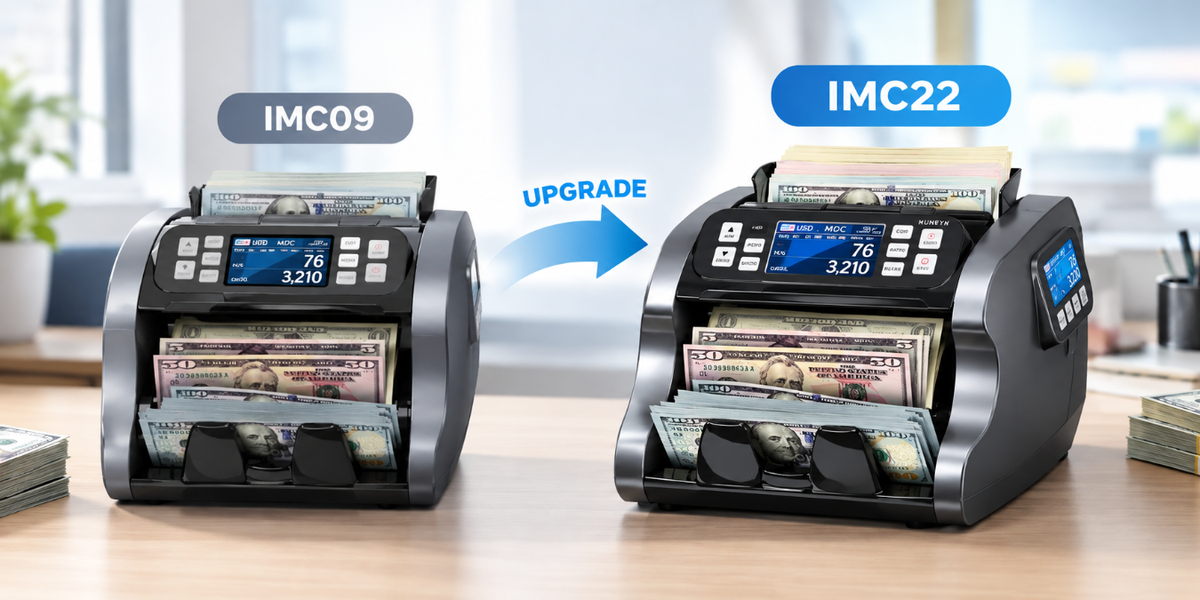
Businesses that want to keep costs lower while still covering the essentials — multi-location retailers, restaurant groups, gas stations — tend to land on the IMC21 or IMC22. Both use a single CIS sensor alongside UV, MG, IR, and MT (still 11 detection layers in total), support multiple currencies (USD, EUR, CAD, MXN, GBP, and others), and count 800–1,200 bills per minute.
For high-volume environments — casino cages, bank branches, wholesale operations — the IMC08 and IMC40 are built for the job. These run up to 12 layers of counterfeit verification, including dual CIS sensors scanning both sides of every note, and two-pocket sorting that automatically separates rejected or suspect bills so counting never has to stop.
Across the range, MUNBYN also builds in things that matter day-to-day rather than just on a spec sheet: printer compatibility for keeping physical records, lifetime currency database updates so the machine doesn't fall behind as new note designs roll out, and worn or slightly damaged bill recognition, since real-world cash is rarely pristine.
The bottom line
UV, MG, IR, and CIS aren't competing technologies — they're complementary checks, each catching what the others might miss. A note that passes a UV scan but fails an infrared check is still rejected. That layered approach is what separates a genuine bank-grade counter from a basic counting tool with a UV light bolted on.
If you're handling cash daily, the question isn't whether you need counterfeit detection — it's how many layers your transaction volume and risk level justify. Matching that to the right money counter is a one-time decision that pays for itself the first time it catches a bill a human eye would have missed. Use the discount code "MYSEO" at checkout to enjoy an additional 8% off your order!

Share:
How to Install MUNBYN Printer Driver on Windows in 2026
Personalized Sticker Ideas for Kids: 15 Creative Ways to Keep Little Ones Busy